Freeze-thaw damage sounds like a problem for Minnesota. Redmond's winters are mild by comparison: the thermometer spends most of December above freezing. Yet brick faces still pop off chimneys here, and mortar joints still crumble on the weather side. The explanation is not how cold it gets but how wet the masonry already is when the cold arrives. This article looks at what the temperature and snow records say for Redmond, Sammamish, Duvall and Carnation, explains the mechanism in plain terms, and lists what to check on your own chimney after a cold snap.
How cold it really gets
On WeatherSpark's averages, Redmond's cool season begins November 13 and ends March 1, some 3.6 months. December is the coldest month, with an average low of 37°F and an average high of 46°F, and the temperature rarely drops below 26°F. Snow is light: a snowy period of about 1.6 months, with January averaging around 1.6 inches.
For the wider lowlands, the Western Regional Climate Center gives January lows that average 28°F to 32°F and January highs that average 41°F to 45°F. Read those two ranges together and the point is clear. On a typical January day the temperature crosses the freezing line overnight and climbs back over it by afternoon. It is that crossing, repeated, that matters to masonry, far more than a single deep freeze.
We could not find a published count of freeze-thaw cycles per year for any of the four towns, so we will not invent one. The nearest long-record measurement is from the Monroe cooperative station, down the Snoqualmie Valley, north of Duvall, where the daily minimum reached 32°F or lower on an average of 58 days a year in a summary covering 1929 to 2012. That is a count of frost days at one station, not of cycles in Redmond, but it shows that frost nights are a routine part of winter in the valley, not a rarity.
| Place | What the record shows | Source |
|---|---|---|
| Redmond | December average low 37°F; rarely below 26°F; January snowfall about 1.6 in. | WeatherSpark |
| Sammamish | December average low 37°F, high 45°F; snow often deeper than in neighboring towns | WeatherSpark; city hazard plan |
| Duvall | Snowy period about 1.8 months; January snowfall about 1.8 in. | WeatherSpark |
| Carnation | Snowy period about 1.8 months; January snowfall about 1.9 in. | WeatherSpark |
| Monroe station (north of Duvall) | 58 days a year at 32°F or lower, 1929–2012 summary | Western Regional Climate Center |
| Puget Sound lowlands | Average January minimum 28°F to 32°F | Western Regional Climate Center |
The exceptions people remember
Averages hide the bad years. Redmond's hazard plan records the 2019 event, when snow fell over nine days and totaled more than 20 inches, while noting that severe winter weather is not typical for the city. Sammamish's plan states that the plateau's altitude brings heavier snow accumulation than surrounding communities and that ice closes many of its steep roads. Go back far enough in Duvall and HistoryLink describes three feet of snow collapsing barns and houses in 1915, followed in 1916 by 40 inches of snow and six inches of ice.
A week of snow sitting on a chimney crown, melting by day and refreezing at night, does more to masonry than a whole ordinary winter. That kind of week is when marginal masonry gives way.
Why wet brick is the real issue
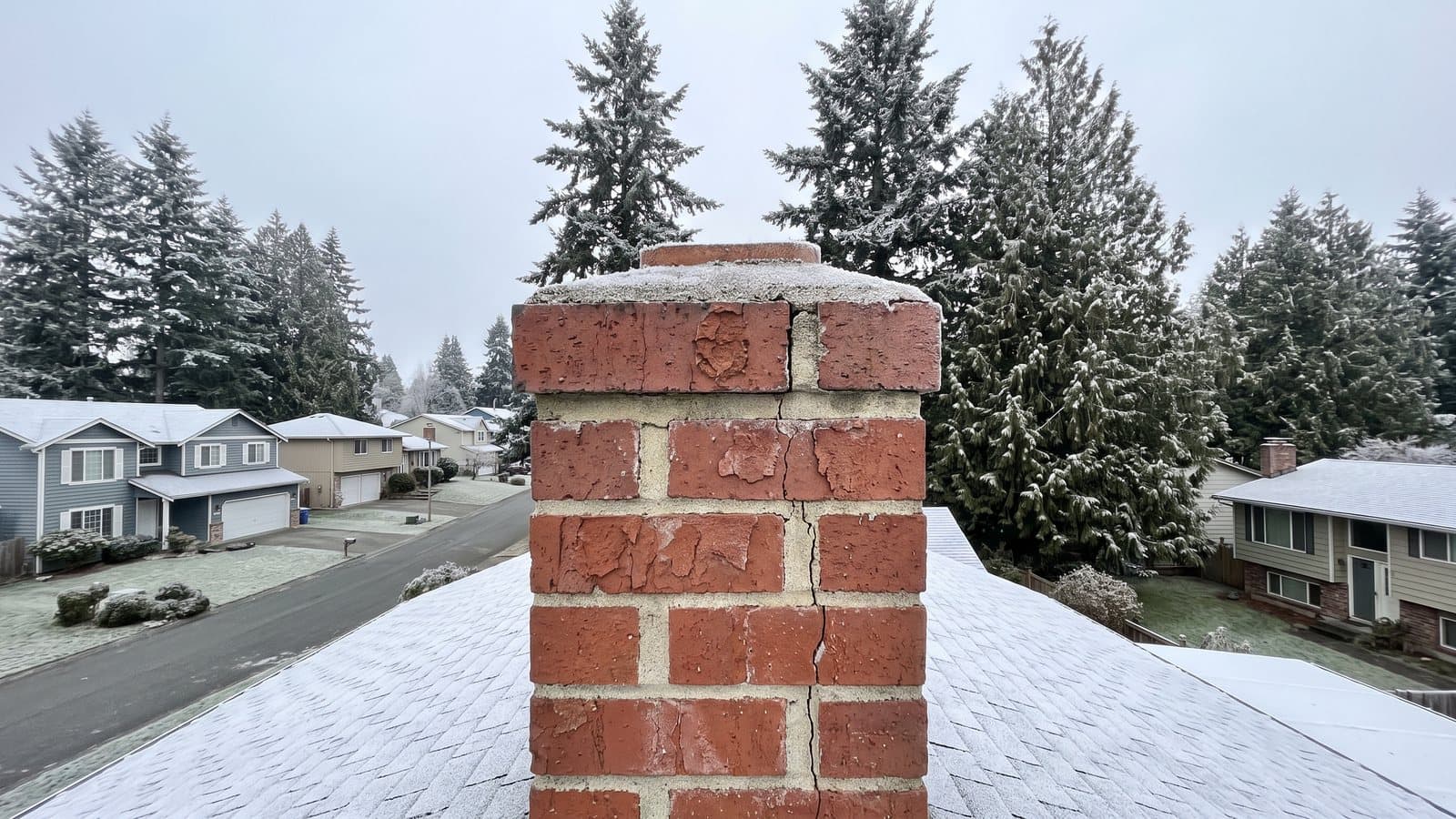
Water expands by roughly nine percent when it turns to ice. Inside a dry brick with a little moisture in its pores, that expansion has room. Inside a saturated brick it has none, and the pressure breaks the pore walls. The fired face separates from the body of the brick and falls away; that is spalling. In mortar the same pressure turns the joint sandy and lets it wash out.
Redmond's cool season sits entirely inside its wet season, which by the same WeatherSpark averages runs from early October to early May, with November the rainiest month. By the time frost nights arrive, an unprotected chimney has had six or seven weeks of regular rain and very little sun to dry it. A mild frost on soaked masonry does more harm than a hard frost on dry masonry. That is the whole local story in one sentence.
Which chimneys are most exposed
Age is part of it. Census ACS estimates for 2020 to 2024 show that about 23 percent of Redmond's housing units were built between 1960 and 1979, and roughly a quarter of all units date from before 1980. Carnation has the oldest stock of the four towns, with about 14.5 percent of its homes built before 1960. A chimney from those decades has been through forty-five or more wet winters, and unless it has been repointed, its joints are the original mortar.
Exposure is the rest. A chimney on an outside wall is cold on three sides. A tall stack on a ridge or hilltop gets more wind-driven rain. The crown matters most of all: Washington's residential code requires the top of a masonry chimney to be sloped so water sheds, with a drip edge that throws it clear of the brick. Many older crowns are flat mortar washes with no overhang, so every rain runs straight down the top courses.
What to look for after a cold snap
Walk around the house on the first dry day and look at the chimney with binoculars. Check the ground and the roof near its base for thin, curved flakes of brick, which are spalled faces. Look for joints that have receded behind the brick edges or show gaps. Look at the crown for cracks or missing chunks, and at the top three or four courses for bricks that seem to have shifted. White powder on the brick shows that water has been moving through the wall.
Inside, a gritty layer of sand or mortar on the smoke shelf or in the firebox after winter is a sign that joints in the flue or smoke chamber are shedding as well.
Repair order and what it costs with us
The sequence is always top-down and structure-first: rebuild or resurface the crown, replace spalled brick, repoint open joints, and only after the new mortar has cured apply a breathable water repellent to slow the next cycle. Doing these out of order wastes money, because a repellent cannot close a crack.
Our masonry repair work, which covers crowns and repointing, starts at $475. General chimney repair on brick and mortar starts at $425, and waterproofing is $285 to $790. The scope decides the figure, so each job is quoted in writing after an on-site inspection billed at $99 plus tax; that $99 comes off the total if you go ahead. Masonry is best done in the dry months, roughly mid-June to early October here, so a chimney that showed damage this winter should be on the calendar by early summer.
Frequently asked questions
Is spalled brick dangerous or only ugly?
A few flaked faces are mainly a warning. Each one exposes the softer core of the brick, which absorbs water faster than the fired surface did, so the damage speeds up. When many bricks or whole courses near the top are affected, the stack can loosen, and pieces can fall onto the roof or the ground. That stage needs repair, not monitoring.
Can I patch flaking brick with mortar or caulk?
A skim of mortar over a spalled face usually pops off within a winter or two, because water gets behind it and the same freezing action lifts it. Caulk in a masonry joint traps water. The lasting repair is to cut out the damaged brick and set a matching one, and to repoint the joints around it.
Why is the damage worse at the top of my chimney?
The top few courses are wetted from above as well as from the sides, they sit in the wind, and they are the coldest part of the stack because the least house heat reaches them. If the crown is cracked, water also enters those courses from inside. Damage that starts under the crown and works downward is the common pattern.
Does a gas fireplace chimney avoid this problem?
No. Freeze-thaw damage is driven by rain and outdoor temperature, not by what burns below. A masonry chimney that vents a gas appliance, or one that is no longer used at all, weathers the same way on the outside.
Sources
- WeatherSpark — Redmond, WA year-round averages — accessed October 4, 2026
- WeatherSpark — Sammamish averages — accessed October 4, 2026
- WeatherSpark — Duvall averages — accessed October 4, 2026
- WeatherSpark — Carnation averages — accessed October 4, 2026
- WRCC — Climate of Washington narrative — accessed October 4, 2026
- WRCC — Monroe station 455525, temperature summary — accessed October 4, 2026
- City of Redmond — hazard mitigation annex — accessed October 4, 2026
- City of Sammamish — hazard mitigation annex — accessed October 4, 2026
- HistoryLink — Duvall thumbnail history — accessed October 4, 2026
- Census Reporter — ACS tables B25034/B25035 — accessed October 4, 2026
- UpCodes — Washington Residential Code 2021, ch. 10 — accessed October 4, 2026
Related services