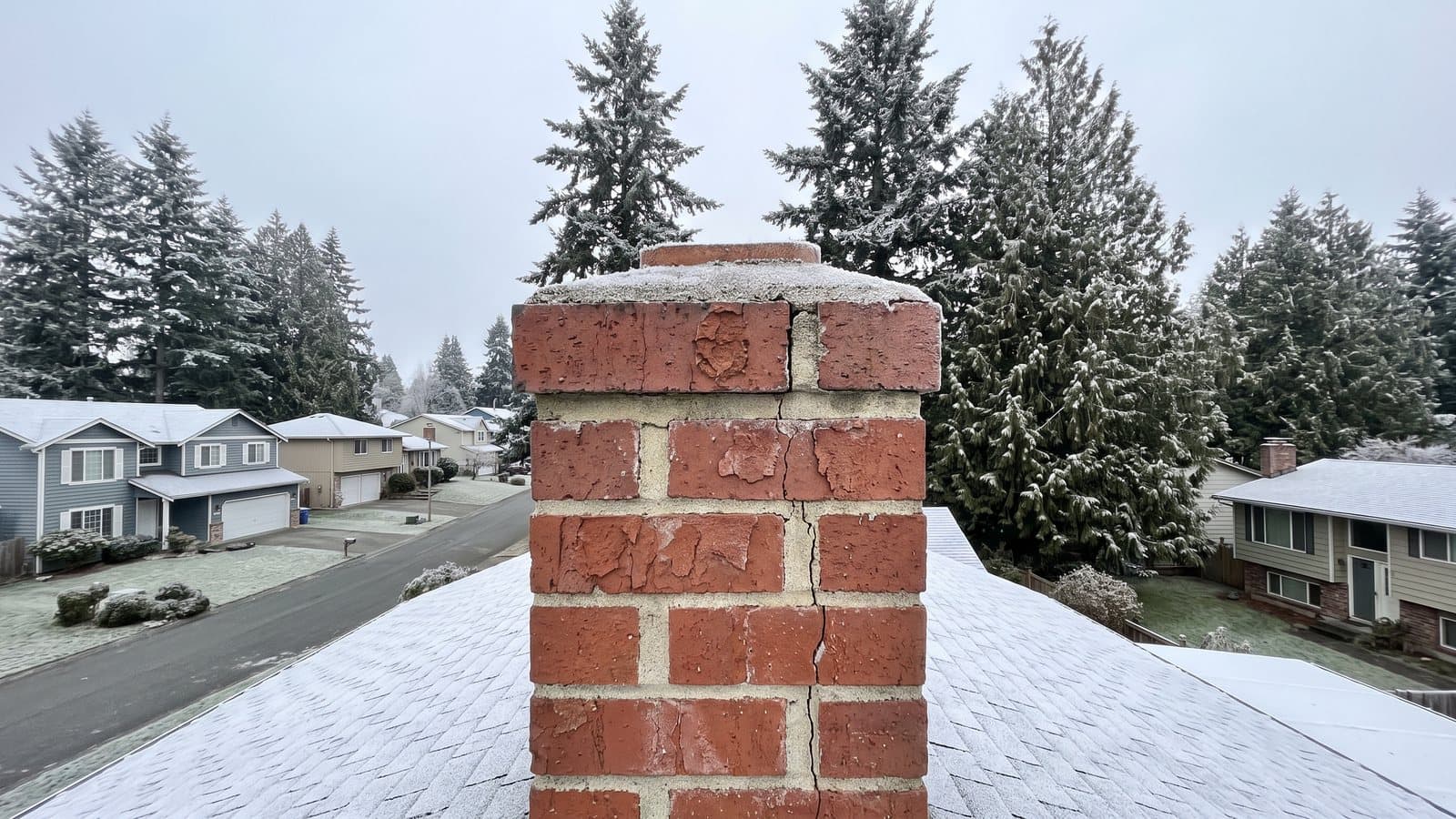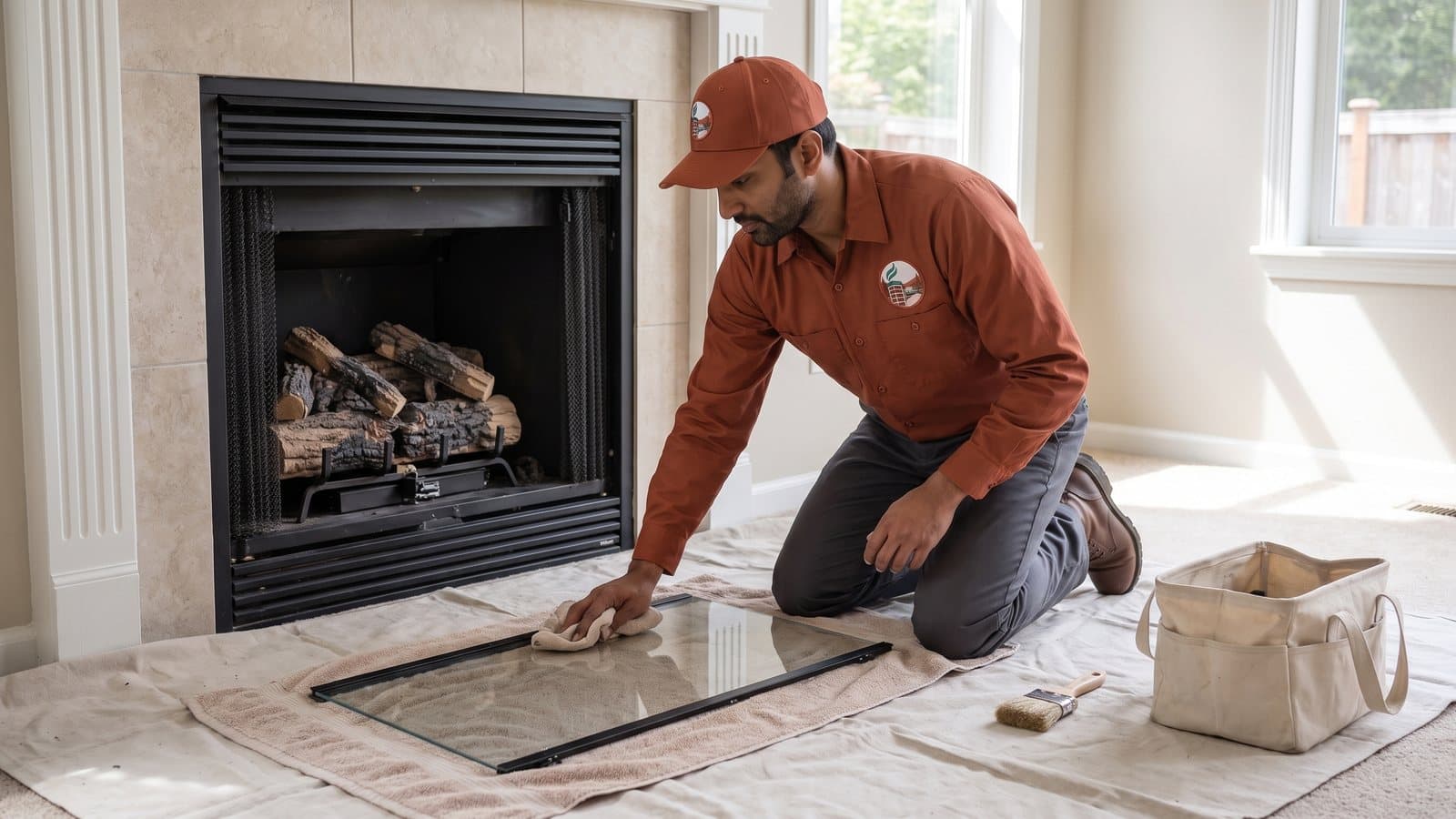
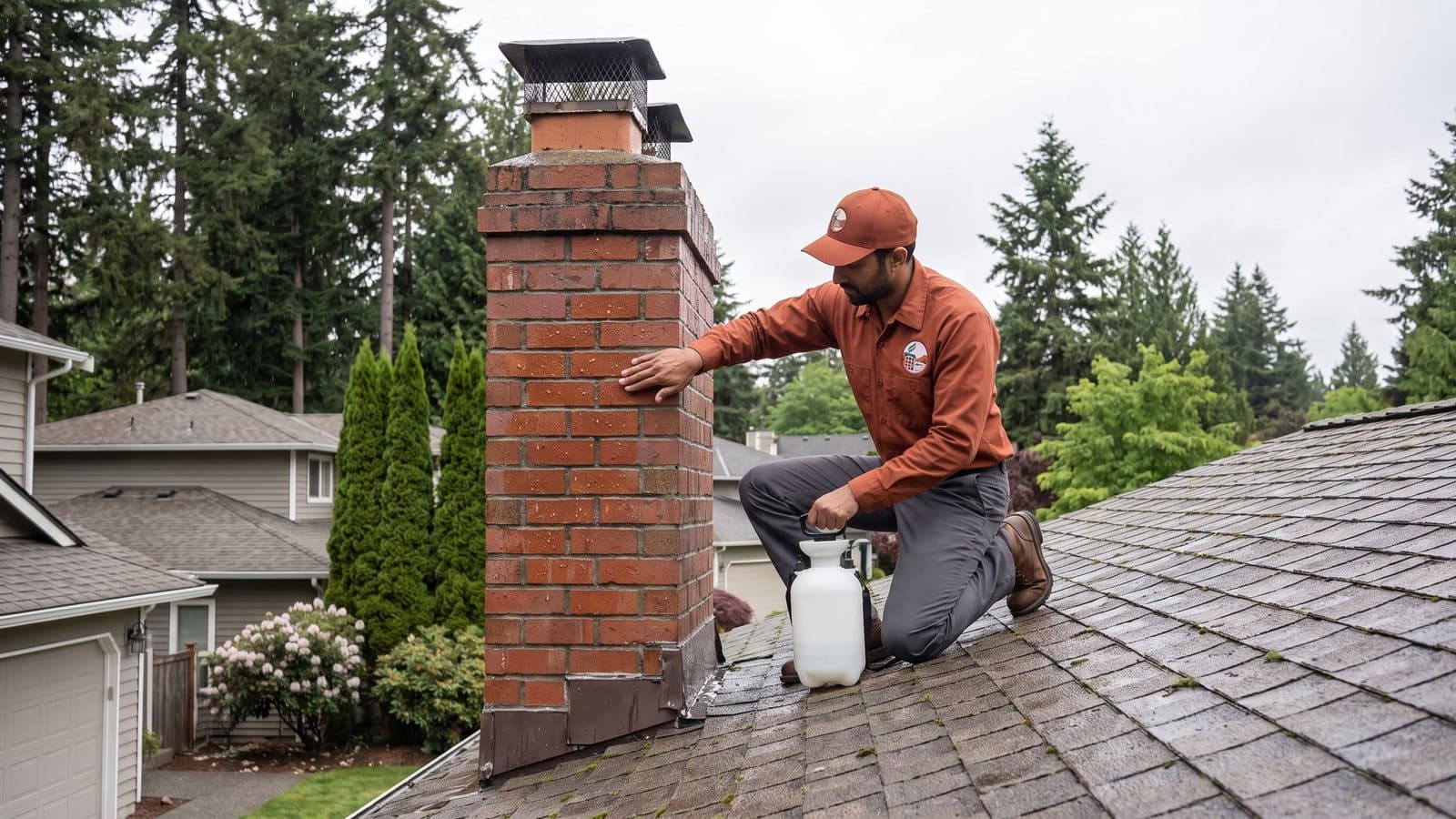
A brick chimney is the one part of a house that stands above the roof with all four sides in the weather and no overhang to shelter it. In a dry climate that hardly matters. In Redmond it matters for more than half the year. This article puts numbers on the local rain, explains the four ways water gets into a chimney, and says plainly where a breathable water repellent helps and where it does nothing. It also covers timing, because in this climate the calendar decides whether the treatment bonds at all.
The rain, in numbers
According to WeatherSpark, Redmond's wetter season opens on October 9 and closes on May 2, a span of roughly 6.8 months. On any day in that span the chance of rain is above 35 percent. November is the wettest month at about 8.7 inches, and July the driest at under an inch.
Total rainfall is only part of the story. Masonry is damaged by staying wet, and what keeps it wet is cloud and humid air. In December, by WeatherSpark's count, cloud covers most or all of Redmond's sky 74 percent of the time. The Western Regional Climate Center's summary of the state's climate is blunter still. West of the Cascades, December and January each log rain or snow on 20 to 25 days, sometimes more. A winter month offers four to eight days with clear or partly clear skies. And in the interior valleys, January relative humidity is around 87 percent at four in the morning and about 78 percent twelve hours later. A north-facing chimney wall wetted in November may not dry through until spring.
The picture gets wetter to the east. The table compares the four communities we serve, all from the same source so the figures are comparable.
| Town | Wetter season | November rain (average) | Wet days in November |
|---|---|---|---|
| Redmond | About 6.8 months (Oct 9 to May 2) | About 8.7 in. | About 17.6 |
| Sammamish | About 7.0 months (Oct 8 to May 8) | About 8.9 in. | About 17.7 |
| Duvall | About 7.0 months (Oct 8 to May 8) | About 9.5 in. | About 18.0 |
| Carnation | About 7.3 months (Oct 7 to May 17) | About 9.8 in. | About 18.0 |
Two long-record stations for context
WeatherSpark's town pages are modeled from regional airports, so it is worth setting them beside measured records. No long-running weather station sits inside any of the four towns, but two are close. At Monroe, the cooperative station that sits north of Duvall where the valley opens out, the yearly average was 47.80 inches of precipitation across records from 1929 to 2016. Up in the Cascade foothills above Carnation, the Tolt South Fork Reservoir station averaged 95.20 inches a year between 1962 and 2016. Homes on the valley floor do not get reservoir-level rain, but those two numbers show how quickly precipitation climbs as you move east from Redmond toward the mountains.
Four ways water enters a chimney
Through the top. A cracked crown or an uncapped flue lets rain fall straight into the structure. The 2021 Washington State Residential Code requires the masonry top to slope so rain runs off, to carry a drip edge, and to have a sealed gap around the flue liner, precisely because this is the most direct route.
Through the joints. Mortar is softer and more porous than brick. Once joints erode and recede, wind-driven rain runs into the wall instead of down its face.
Through the roof line. Where the chimney passes through the roof, metal flashing and sealant keep water out of the attic. A stain on the ceiling near the fireplace almost always traces to this joint, not to the brick.
Through the brick itself. Brick is porous, and soft or older brick is more porous still. This is the only one of the four paths that a water repellent addresses.
What a repellent does, and what it cannot do
A masonry water repellent of the silane or siloxane family soaks into the surface and lines the pores so that liquid water beads and runs off, while water vapor can still escape from inside. That second property is the important one. A chimney always takes in some moisture from the flue gases and from the house, and it has to be able to dry outward.
This is why paint, clear acrylic sealers and roofing products are the wrong choice. They form a film. Moisture collects behind the film, and the brick face eventually separates and falls away with the coating attached.
A repellent does not bridge an open joint, does not seal a cracked crown and does not repair flashing. Applied over those defects it protects the sound brick and leaves the actual leak untouched. So the order is fixed: cap and crown first, then joints and damaged brick, then flashing, and the repellent last, after new mortar has cured.
A quick test you can do yourself
Pick a dry day after several dry days. From a safe spot, spray a little water on reachable brick, for example low on an exterior chimney at ground level. If the water beads and rolls off, the surface is still shedding. If the brick darkens at once and the dark patch spreads, it is absorbing, and that is what the whole stack is doing every wet day from October to May.
Also look at the chimney the morning after rain. Brick that is still dark when the driveway and siding have dried is holding water. Moss on the shaded side tells the same story; Oregon State University Extension describes how moss traps debris and holds moisture against the surface it grows on.
Timing, and what we charge
WeatherSpark places the clearer part of Redmond's year from about June 16 to October 7, some 3.7 months. That is the working window. Muggy days are essentially absent here all year, so summer brick dries fast and takes the treatment well. Booking in July or August leaves room for any crown or joint repair to cure before the repellent goes on, and the chimney is protected before the November peak.
We charge $285 to $790 to waterproof a chimney, priced by how tall and how wide the stack is and by the cleaning the brick requires beforehand. Any repair the chimney needs beforehand is quoted on its own line. The starting point is a visit to inspect the chimney, billed at $99 plus tax; once you sign off on the quote, the $99 is subtracted from the job total.
Frequently asked questions
How long does a water repellent last on a chimney?
It depends on the product and on how exposed the chimney is, and each manufacturer publishes its own figure. We write the product name on the invoice so the next person who looks at the chimney knows what was applied and can check the brick against that product's stated life.
Will waterproofing fix white stains on the brick?
The white deposit is salt left behind when water that has traveled through the masonry evaporates at the surface. A repellent reduces the amount of water going in through the brick face, which reduces new staining. It does not remove existing deposits, and if the water is entering through the crown or the flue, the stains will keep coming until that path is closed.
Can waterproofing be done in winter?
The brick has to be dry to accept the treatment and needs dry weather afterward. In Redmond the dependable dry window opens in mid-June and closes in early October. A winter application is possible only in an unusual dry spell, and we would rather schedule it for summer than gamble on one.
Does a stone or stucco chimney need the same treatment?
Not necessarily. Dense natural stone absorbs far less water than soft brick, and its weak point is the mortar. Stucco and manufactured stone veneer are separate systems with their own drainage details. The inspection tells you which material you have and whether a repellent suits it.
Sources
- WeatherSpark — Redmond, WA year-round averages — accessed October 4, 2026
- WeatherSpark — Sammamish averages — accessed October 4, 2026
- WeatherSpark — Duvall averages — accessed October 4, 2026
- WeatherSpark — Carnation averages — accessed October 4, 2026
- WRCC — Climate of Washington narrative — accessed October 4, 2026
- WRCC — Monroe station 455525, monthly summary — accessed October 4, 2026
- WRCC — Tolt South Fork Reservoir station 458508 — accessed October 4, 2026
- UpCodes — Washington Residential Code 2021, ch. 10 — accessed October 4, 2026
- Oregon State University Extension — controlling roof moss — accessed October 4, 2026
Related services