Nobody can give you an honest number of years for a chimney cap, because a cap does not wear out on a calendar. It wears out on weather. In Redmond that means roughly seven months a year of frequent rain, a windy season that overlaps almost exactly with the wet one, and, on wooded lots, branches coming down in winter storms. The useful question is not how old the cap is but what it is made of, how it is fastened and what it looks like today. This guide walks through each of those, and through the handful of signs that mean the cap should be changed now instead of at the next visit.
The short answer: look every year, replace on condition
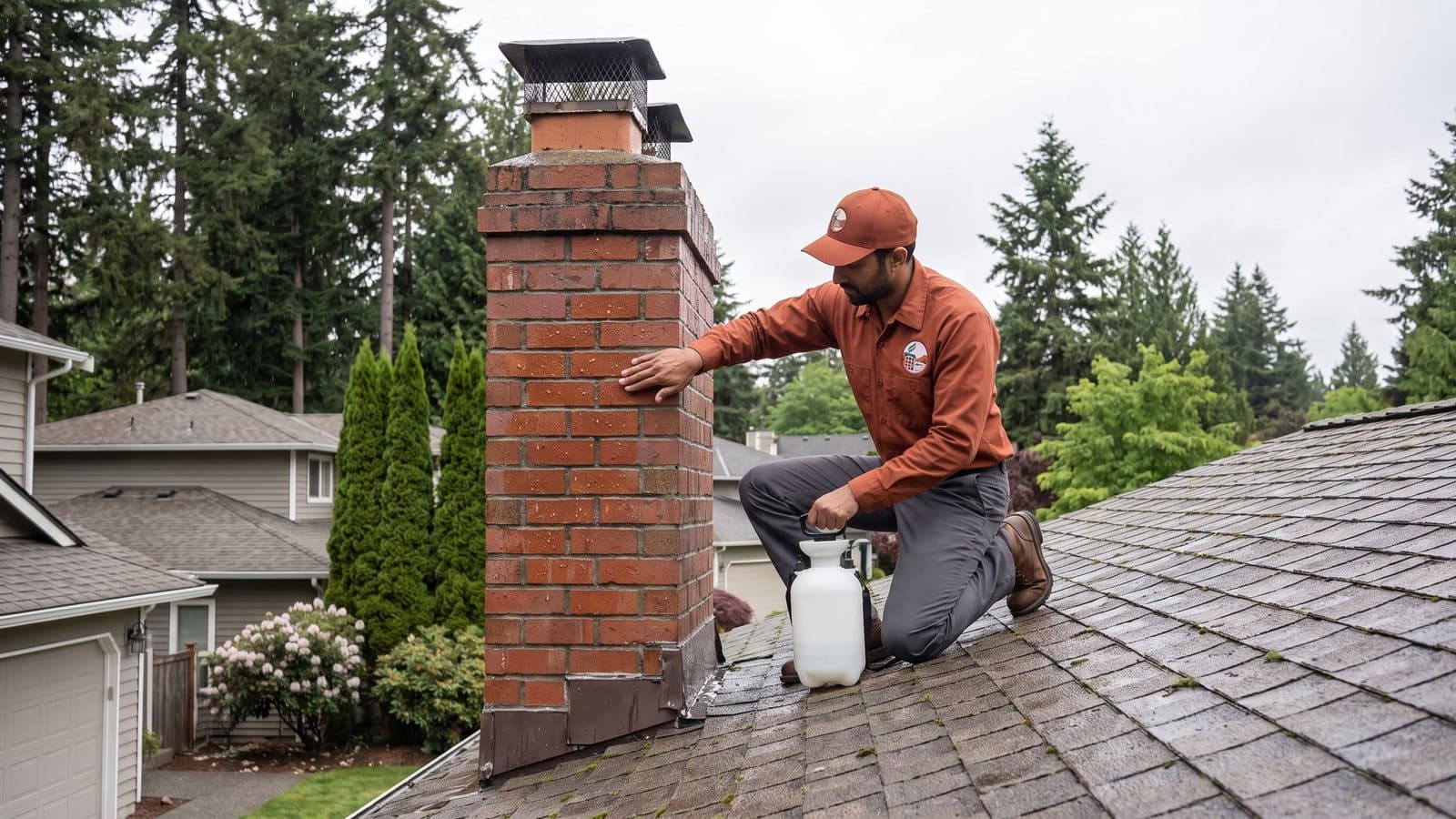
NFPA 211, the national chimney standard, asks for a look at each chimney, fireplace and vent once every year; CSIA, the sweep certification body, passes that wording on to homeowners. The cap is the first thing a technician sees from the roof, so it gets looked at on that same visit. A cap that is tight, square, unrusted and clear of debris stays. One that fails any of those four tests gets repaired or replaced.
That is a less satisfying answer than a number, but it is the accurate one. Two caps installed the same week on the same street can end up in very different shape, depending on the metal, the trees overhead and whether the roof faces the weather.
What Redmond weather does to a cap
Start with rain. On WeatherSpark's long-term averages, Redmond's wetter season starts October 9, ends May 2 and so covers some 6.8 months. November is the peak, with around 8.7 inches of rain spread over 17 to 18 wet days. A cap spends most of that stretch damp, and damp steel with a scratched or thin coating rusts.
Then wind. The same source gives Redmond a windier period of about 5.9 months, from mid-October to mid-April, with the wind coming mostly from the south. The Western Regional Climate Center adds that across western Washington late fall and winter bring the strongest winds, generally out of the south or southwest. The city's own hazard plan describes a hill-and-valley terrain that funnels wind in several places, and it singles out the steep slopes of Education Hill as likely to take the worst of a severe storm. The same plan looks back at the windstorm of December 2018, when gusts reached 45 mph. A cap held by four small screws into a clay flue tile, or by a pressure band that was never retightened, is the one that ends up in the yard after a night like that.
Trees are the third factor. Next door in Sammamish, the city's hazard plan says 48 percent of the land is under tree canopy and that winter storms regularly bring down limbs. Any Redmond roof with tall firs or maples above it is exposed in the same way. A limb does not need to be large to bend a cap lid or tear the mesh, and needles and leaves that pile against the screen hold water on the metal long after the rain stops.
Farther east the rain increases. WeatherSpark's November average is about 9.5 inches for Duvall and 9.8 inches for Carnation, where the wet season runs about 7.3 months. Caps in the valley simply get more wet days per year than caps in town.
How each material ages
The metal decides how the cap fails. This table is general trade knowledge, not a warranty statement; a manufacturer's own warranty tells you what that product is expected to do.
| Cap material | How it usually fails in a wet climate | What to check each year |
|---|---|---|
| Galvanized steel | The zinc coating wears through, then the steel rusts and stains the crown | Orange streaks, flaking at the seams, soft spots in the lid |
| Painted black steel | Paint chips at edges and fasteners; rust starts underneath | Bubbling paint, rust at screw heads |
| Stainless steel | Rarely the metal itself; more often fasteners, a bent lid or clogged mesh | Tightness, mesh condition, shape of the lid |
| Copper | Turns brown then green, which is cosmetic; damage is usually impact | Dents, loose soldered joints, runoff stains on brick |
Five signs the cap should be changed now
Rust trails on the crown or down the brick. By the time rust is running, the coating is gone and the metal is thinning. The stain is also iron-rich water soaking into the masonry.
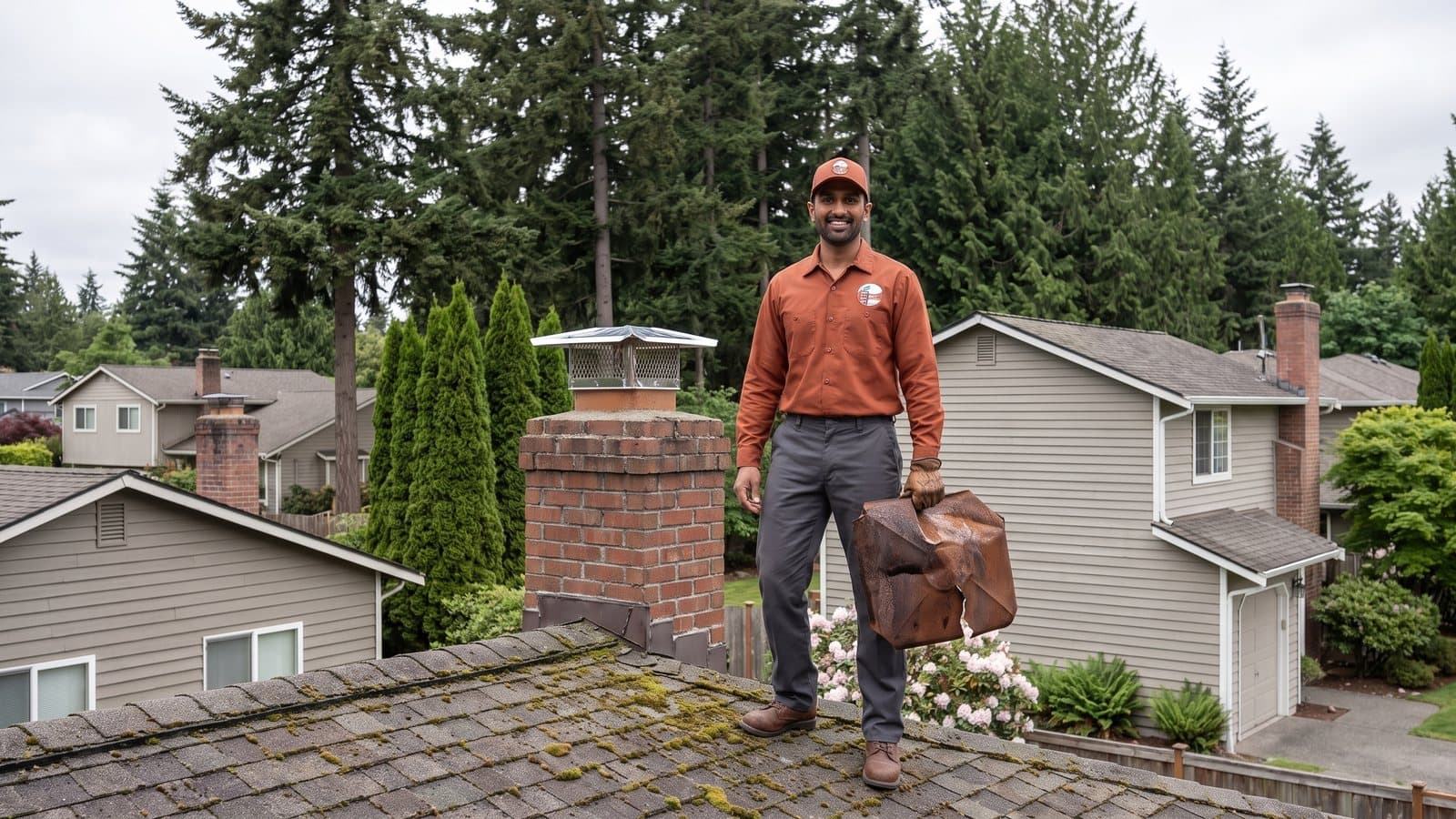
A lid that has shifted or lifted. If the cap sits crooked or rattles in wind, the attachment has failed. The next strong southerly can take it off entirely, and a flue with no lid lets rain fall directly on the smoke shelf and the damper.
Torn or missing mesh. Birds and squirrels look for exactly this kind of opening in spring. Where a spark arrestor is installed, the Washington residential code is specific: the openings must not let a half-inch sphere through, must not be so fine that a three-eighths-inch sphere is blocked, and the screen's net open area must equal the flue outlet's area four times over, or more. Mesh patched with hardware cloth from the garage rarely meets that.
Mesh blocked with soot or creosote. This is a draft problem before it is a cap problem, and it usually means the flue is due for a sweep. A screen that clogs again and again may be too fine for the appliance.
Water or debris in the firebox. Drips on the hearth after rain, twigs on the damper or a musty smell can each point to a cap that has stopped doing its job, though the crown and the flashing need to be ruled out as well.
Cap, crown, chase cover: three different parts
People often use one word for all three, and that can lead to buying the wrong repair. The cap is the metal hood over the flue opening. The crown is the sloped masonry or concrete slab that closes the top of a brick chimney around the flue. The 2021 Washington State Residential Code, which the City of Redmond has enforced since March 15, 2024, requires that top to be concrete, metal or stone, sloped so water runs off, with a drip edge and a caulked gap around the flue liner. A chase cover is the sheet-metal pan on top of a framed, sided chimney around a factory-built fireplace.
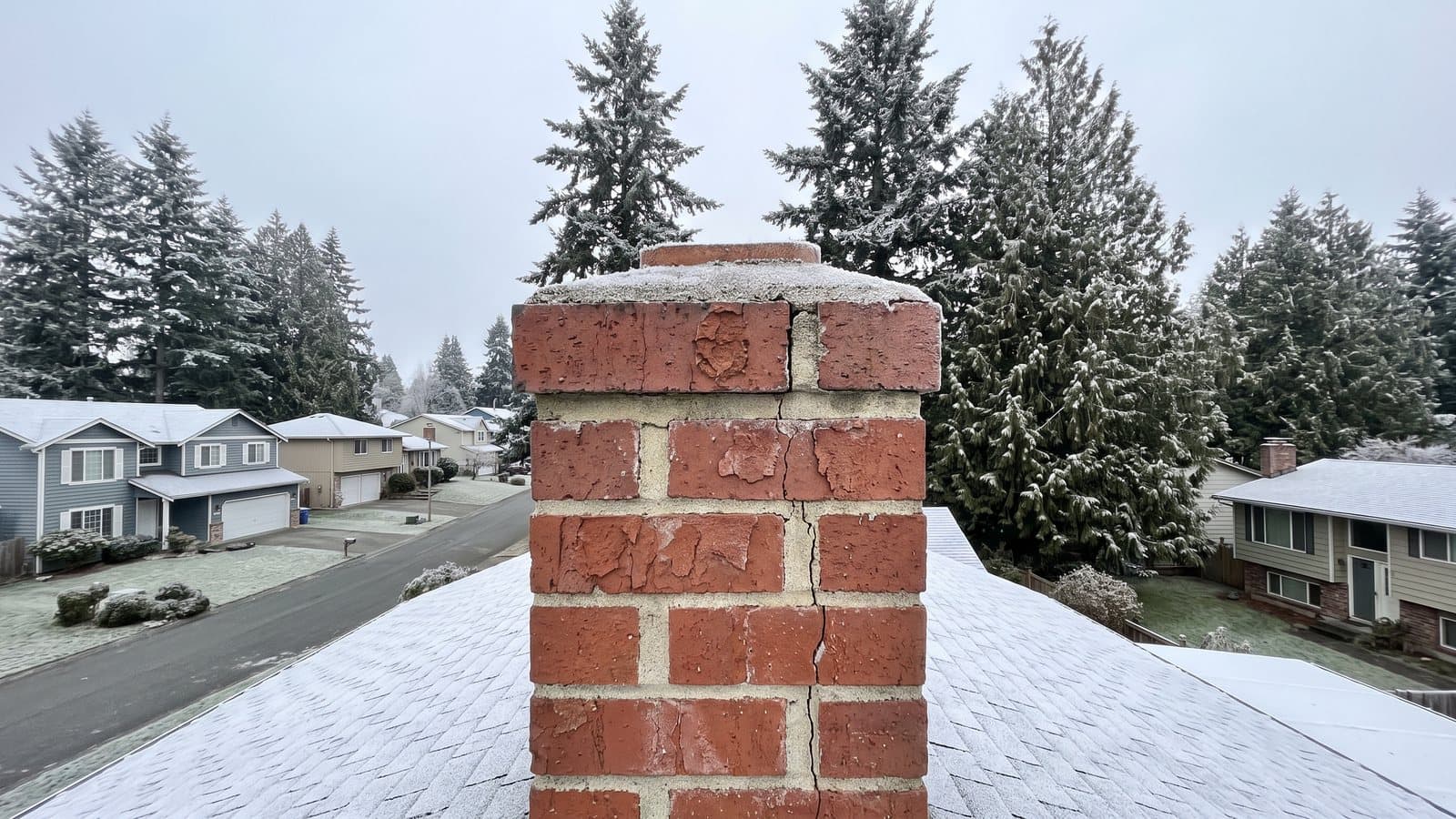
A new cap on a cracked crown solves half the problem. If the inspection finds both, the quote lists them as two lines, so the role of each repair is visible.
What we charge and how the visit works
A chimney cap installed by us is $235 to $850. The spread comes from the size of the cap, from how many flues it has to cover and from whether it must be custom made. We do not price a cap from a photo taken on the lawn, because the flue has to be measured and the crown checked.
It starts with a technician on the roof: the inspection visit is billed $99 plus tax, and the $99 is deducted from the written quote the day you accept it. Late summer is the easy time to book: the roof is dry, and the cap is on before the October rain returns.
Frequently asked questions
Does Washington's building code make a rain cap mandatory?
The state residential code requires the masonry top of the chimney, which the code calls a cap and the trade calls a crown, to be sloped and to shed water. A metal rain cap over the flue is not spelled out as mandatory in the sections we cite here, but the State Fire Marshal recommends one, and where a spark arrestor is fitted the code sets its mesh size and open area.
Can I tell from the ground whether my cap needs replacing?
Partly. Binoculars will show a missing lid, a cap sitting crooked, torn mesh or orange streaks running down the crown. They will not show a loose fastener, a hairline split in a welded seam or mesh that is half blocked with soot. Those are found from the roof.
Does a gas fireplace flue need a cap too?
A flue that vents a gas appliance through a masonry chimney is still an open pipe to the sky, so rain, nests and leaves get in the same way. Factory-built and direct-vent units have their own listed termination, which is replaced with the part the manufacturer specifies, not with a generic cap.
What does a replacement cap cost with you?
Our installed price for a chimney cap is $235 to $850. Expect the low end for a stainless cap on one flue and the high end for a multi-flue or made-to-measure cap. Count $99 plus tax for the visit to inspect the chimney; we subtract it on the invoice after you approve the quote.
Sources
- WeatherSpark — Redmond, WA year-round averages — accessed October 4, 2026
- WeatherSpark — Duvall averages — accessed October 4, 2026
- WeatherSpark — Carnation averages — accessed October 4, 2026
- WRCC — Climate of Washington narrative — accessed October 4, 2026
- City of Redmond — hazard mitigation annex — accessed October 4, 2026
- City of Sammamish — hazard mitigation annex — accessed October 4, 2026
- UpCodes — Washington Residential Code 2021, ch. 10 — accessed October 4, 2026
- City of Redmond — 2024 code adoption flyer — accessed October 4, 2026
- CSIA — homeowner resources (NFPA 211 wording) — accessed October 4, 2026
- State Fire Marshal — home heating safety (2026) — accessed October 4, 2026
Related services